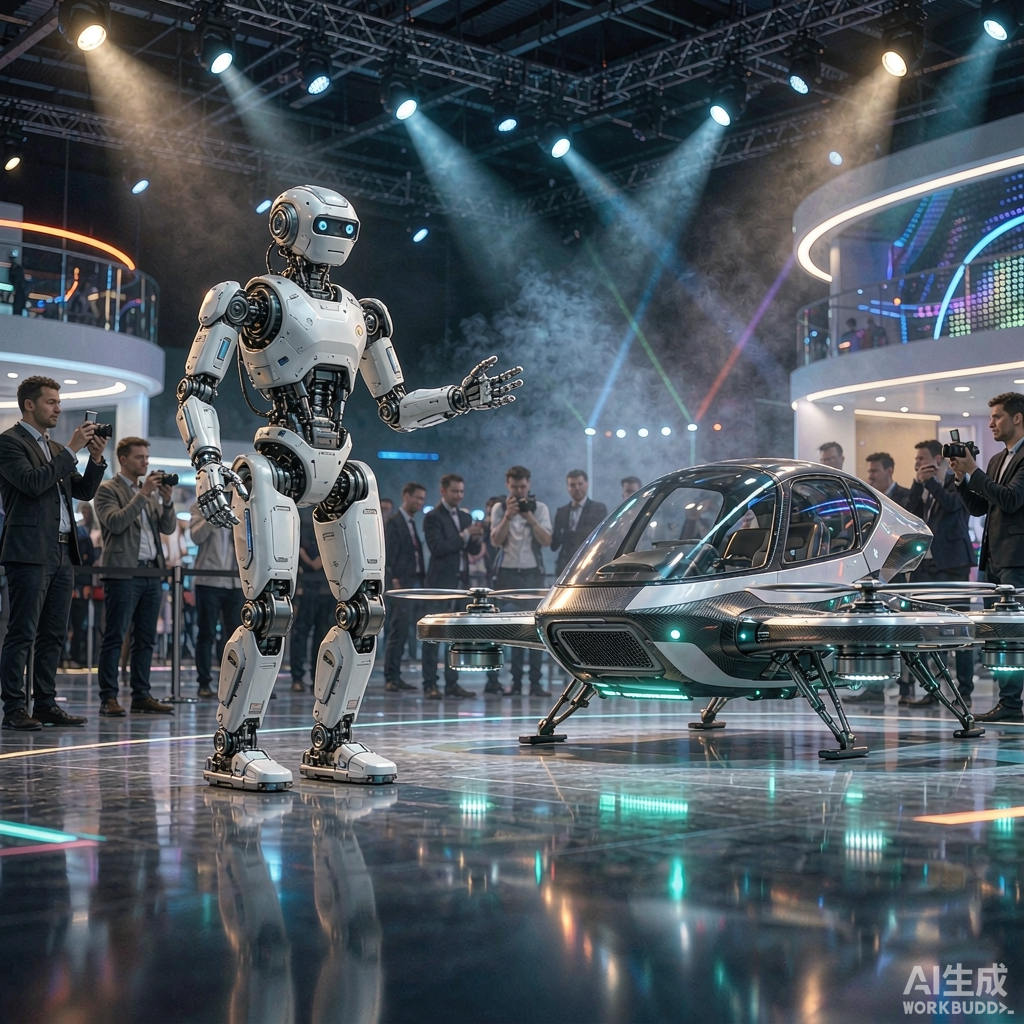



At the 2026 Web Summit in Lisbon, a batch of Chinese innovations took the spotlight - from wheeled dual-arm robots operating autonomously in convenience stores to modular flying cars bridging ground and air - clearly tracing a trend: artificial intelligence is accelerating from pure digital space into physical AI and embodied intelligence.
In the embodied-intelligence exhibition area, Chinese company Galbot demonstrated a wheeled, dual-arm robot capable of visual-language-action coordinated decision-making for convenience stores, pharmacies and industrial settings. On the opening main stage, Xpeng Aeroht founder Zhao Deli presented a modular flying car, exploring solutions to real-world challenges of movement, parking and recharging.
How to lower the barrier to using large models so that small firms and independent developers can share AI dividends was another key discussion. At the "Open Source Advantage" session, Chinese firms ModelBest and MiniMax joined international investors to exchange views on data management, computing costs and innovation efficiency. From generative agents to walking robots, from low-speed delivery networks to low-altitude mobility, Chinese innovation is broadening AI's radius.