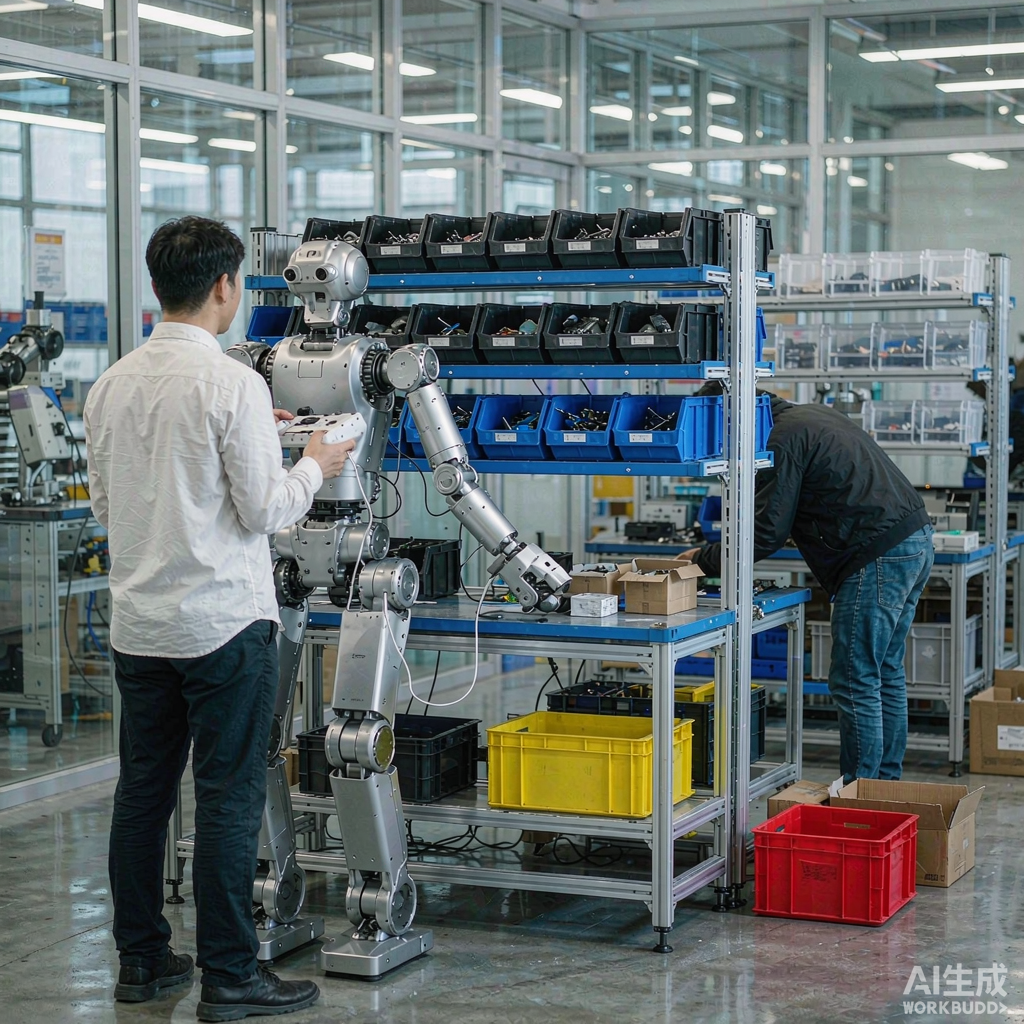



At the Hubei Humanoid Robot Innovation Centre in Wuhan, 22-year-old Li Bixiu guides a humanoid robot through a warehouse task using a controller: reaching for an item on a shelf, gripping it, turning and placing it in a shopping basket. His current assignments include removing expired goods and putting up promotional signs. A camera on the robot's wrist records the visual feed and movement trajectories, which are sent to a backend platform for review, annotation and repeated rounds of training.
Li is one of 40 artificial intelligence trainers at the centre, with an average age just over 20. Colleague Qi Dan says the work is slow and precise: teaching a robot to perform what looks like a simple action can take two to three months. The data collected from different scenarios is labelled and fed to large models so robots can gradually learn to complete tasks on their own, moving from what the trainers call primary-school to university level.
Similar robot schools are appearing across the country, including the Beijing Humanoid Robot Innovation Centre, an embodied-intelligence training ground run by China Xiong'an Group, a Guangxi data collection and testing centre and a humanoid robot data training facility in Qingdao. China's 15th Five-Year Plan proposes making embodied intelligence a new economic growth point. Policy steps include a May guideline on the standardized application and innovative development of intelligent agents, a June notice from the Ministry of Industry and Information Technology calling for more than 100 high-value application scenarios, and an October directive from the Ministry of Commerce to expand embodied intelligence use in retail, home services and logistics.
Industry representatives say the goal is to move robots from performing on stage to doing useful work, and from occasional success to stable, reliable performance across different environments. That requires far more real-world training data, and a new profession is taking shape around producing it.