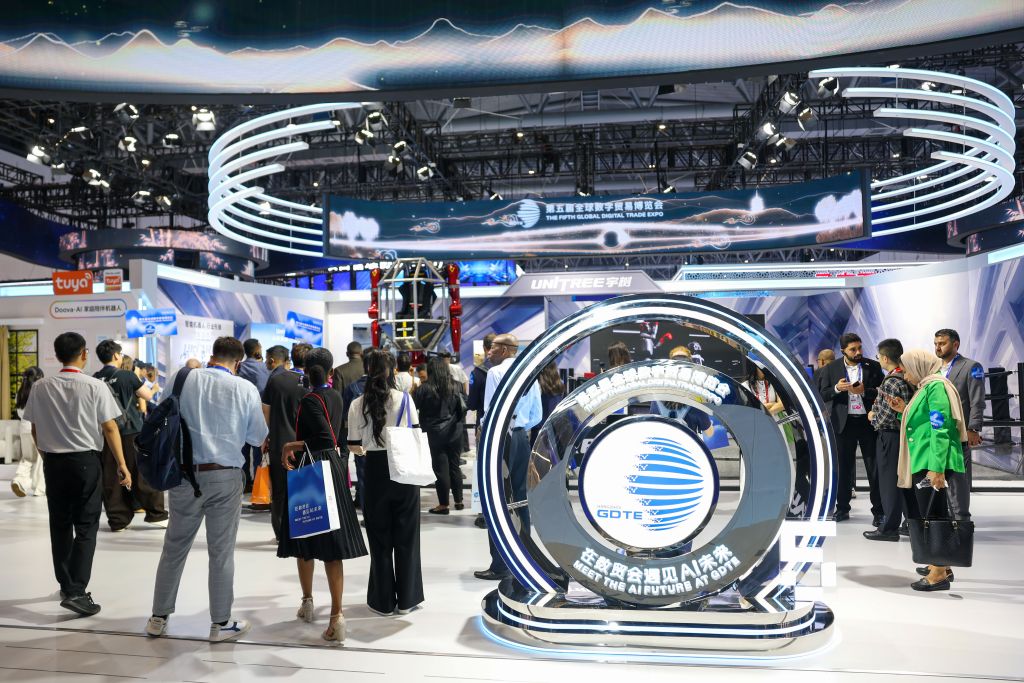



Huawei's rotating chairman Xu Zhijun made a striking claim at the Huawei Connect (HC) 2026 conference in Shanghai: in the Chinese market, Huawei's Ascend AI computing share has already surpassed Nvidia's.
Speaking alongside HiSilicon chief scientist Liao Heng, Xu presented Huawei's newly released Peerium computing architecture for the AI era and the Lingqu (UnifiedBus) solution, saying Peerium can make one million processors operate as a single computer. Huawei is currently deploying and testing an Atlas 950 SuperPoD supernode at a scale of 256,000 cards.
Xu noted that "supernode" is widely used these days, but implementations vary greatly between vendors; the real challenge is making thousands or tens of thousands of processors act as one computer. "The key issue going forward may not be how hard we push, but how much we can supply. Produce as much as we can now, and we hope the industry chain accelerates capacity expansion — faster, and more."
Huawei's Ascend 950 chip comes in PR and DT versions. The Ascend 950PR, released and launched in the first quarter of 2026, targets inference scenarios, though Xu disclosed that its shipment volume has not been large. SuperNodes based on 950DT are for training, currently in testing, with volume supply expected by the end of this year or early next year.
"From current test results, the training performance of 950DT is very good. I believe from next year, a large amount of model training will be built on 950DT supernodes," Xu said.
Liao Heng forecast that within the next two years, China will see roughly six to seven frontier AI laboratories, all targeting foundation models with parameter scales between 10 trillion and 40 trillion. These figures broadly match the memory capacity and scale of the supernodes, meaning infrastructure at this scale is required for training.
On market share, Xu said it is difficult to statistically determine Nvidia's share in the Chinese market, but based on data Huawei can track, Ascend should already have surpassed Nvidia. He added that Ascend's supply still falls far short of domestic market demand, so Huawei has no plans for broad overseas expansion, though a small number of countries have conducted testing and supply arrangements in very limited volumes.
On optical interconnect, Xu said Huawei reached consensus early on pursuing NPO rather than CPO, and believes that for a considerable time NPO remains the best choice in terms of engineering implementation, cost, maintenance and yield. Huawei recently released the NPO-based Hi-ONE module supporting 7.2T bandwidth, with the optical engine positioned only about five centimeters from the main chip, requiring copper only for that section — essentially making it an all-optical supernode. The Hi-ONE module packages the light source directly inside the module.