VIP member

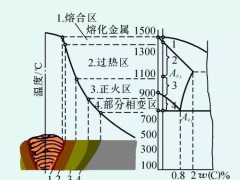
Unlike the weld metal, the heat-affected zone (HAZ) cannot be adjusted through chemical composition. Its properties are formed entirely under the welding thermal cycle, which produces a non-uniform microstructure distribution. For general welded structures, the main concerns are hardening, embrittlement, toughening and softening of the HAZ, as well as overall mechanical, corrosion and fatigue performance, depending on the service requirements of the structure.
1. HAZ hardening. The hardness of the HAZ mainly depends on the chemical composition of the steel and the cooling conditions. The maximum hardness (Hmax) near the fusion line is commonly used to judge HAZ performance and to indirectly predict toughness, brittleness and crack resistance. Even for the same microstructure, hardness varies with carbon content, alloying elements and cooling rate.
2. HAZ embrittlement. Embrittlement is a main cause of cracking and brittle fracture of welded joints. Typical forms include coarse-grain embrittlement, precipitation embrittlement, transformation embrittlement, hot strain aging embrittlement, hydrogen embrittlement and graphitization. Coarser grains raise the ductile-brittle transition temperature; precipitation of carbides, nitrides and intermetallic compounds during aging or tempering raises strength and hardness but also brittleness; for low-carbon low-alloy high-strength steels, M-A constituent, upper bainite and coarse Widmanstatten structure are the main causes, while for steels with carbon content above about 0.2%, high-carbon martensite dominates.
3. HAZ toughening. Measures include controlling the microstructure - keeping carbon content low with a multi-element micro-alloying system to obtain low-carbon martensite, lower bainite and acicular ferrite - and post-weld heat treatment for important structures. A well-designed welding procedure with proper heat input, preheating and post-heating is an effective way to improve HAZ toughness. Fine-grain controlled steels and clean steelmaking (very low S, P, O, N) further improve toughness.
4. HAZ softening. For metals strengthened by cold working or heat treatment before welding, strength loss occurs in the HAZ after welding. The lower the tempering temperature before welding (i.e. the higher the initial strength), the more severe the post-weld softening. Experiments show the most obvious softening occurs in the zone heated between A1 and A3.